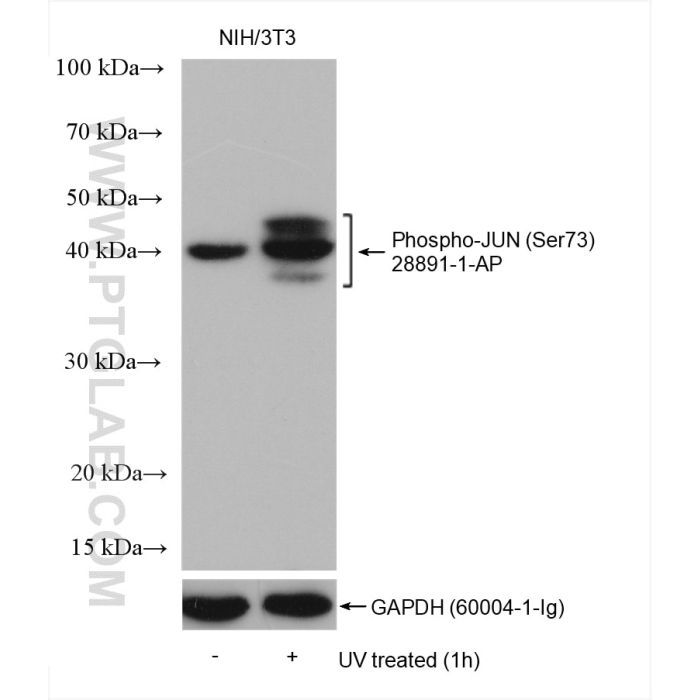
Phospho-JUN (Ser73) Polyclonal antibody proteintech 28891-1-AP
$449.00
In stock
SKU
28891-1-AP
| Host / Isotype: Rabbit / IgG | Class: Polyclonal |
| Reactivity: Human, Mouse, Rat And More (2) | Immunogen: Peptide Predict reactive species |
| Applications: WB, IF/ICC, CoIP, ELISA | Observed Molecular Weight: 331 aa, 36 kDa |
| Formulation: PBS, Azide, Glycerol | GenBank Accession Number: BC068522 |
| Conjugate: Unconjugated | Gene Symbol: JUN |
| Tested Applications: Positive WB detected in | Gene ID (NCBI): 3725 |
| Application: Western Blot (WB) | RRID: AB_2881228 |
| Dilution: WB : 1:500-1:2000 | Conjugate: Unconjugated |
| Tested Reactivity: Human, Mouse, Rat | Form: Liquid |
| Host / Isotype: Rabbit / IgG | Background Information: JUN is also named as c-Jun and AP1, belongs to the bZIP family and Jun subfamily. JUN, the most extensively studied protein of the activator protein-1 (AP-1) complex, is involved in numerous cell activities, such as proliferation, apoptosis, survival, tumorigenesis and tissue morphogenesis (PMID: 22180088). JUN is a transcription factor that recognizes and binds to the enhancer heptamer motif 5'-TGA[CG]TCA-3'. It promotes activity of NR5A1 when phosphorylated by HIPK3 leading to increased steroidogenic gene expression upon cAMP signaling pathway stimulation. JUN is a basic leucine zipper (bZIP) transcription factor that acts as homo- or heterodimer, binding to DNA and regulating gene transcription (PMID: 9732876). In additon, extracellular signals can induce post-translational modifications of JUN, resulting in altered transcriptional activity and target gene expression (PMID:8464713). More over, it has uncovered multiple layers of a complex regulatory scheme in which JUN is able to crosstalk, amplify and integrate different signals for tissue development and disease. Jun is predominantly nuclear, ubiquitinated Jun colocalizes with lysosomal proteins (PMID: 15469925). This antibody is raised against synthetic phosphopeptide corresponding to residues surrounding Ser73 of human JUN, which can detect the bands around 42-45 kDa. |