VE-cadherin/CD144 Polyclonal antibody proteintech 27956-1-AP
$449.00
In stock
SKU
27956-1-AP
| Host / Isotype: Rabbit / IgG | Class: Polyclonal |
| Reactivity: human | Immunogen: CatNo: Ag27487 Product name: Recombinant human CDH5 protein Source: e coli.-derived, PGEX-4T Tag: GST Domain: 54-241 aa of NM_001795 Sequence: MHIDEEKNTSLPHHVGKIKSSVSRKNAKYLLKGEYVGKVFRVDAETGDVFAIERLDRENISEYHLTAVIVDKDTGENLETPSSFTIKVHDVNDNWPVFTHRLFNASVPESSAVGTSVISVTAVDADDPTVGDHASVMYQILKGKEYFAIDNSGRIITITKSLDREKQARYEIVVEARDAQGLRGDSGT Predict reactive species |
| Applications: WB, IHC, IF/ICC, FC, ELISA | Observed Molecular Weight: 88 kDa |
| Formulation: PBS, Azide, Glycerol | GenBank Accession Number: NM_001795 |
| Conjugate: Unconjugated | Gene Symbol: VE-cadherin |
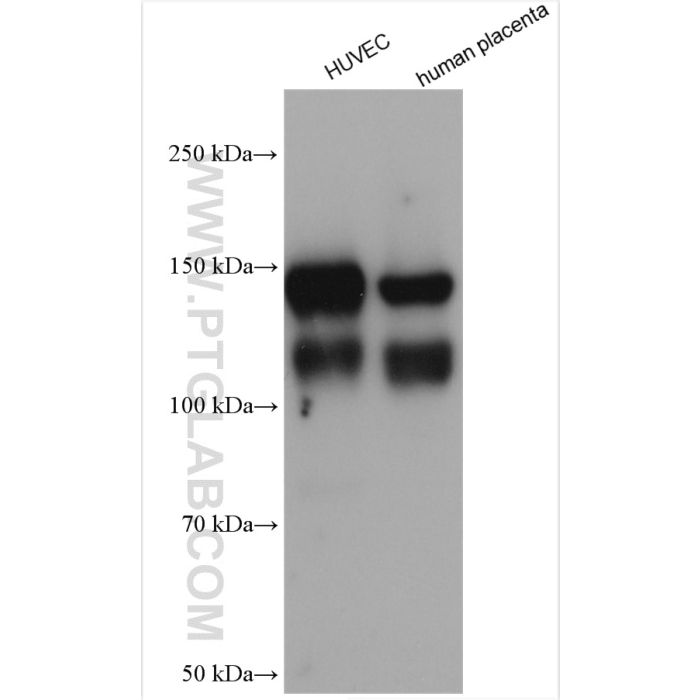
| Tested Applications: Positive WB detected in | Gene ID (NCBI): 1003 |
| Application: Western Blot (WB) | RRID: AB_2918136 |
| Dilution: WB : 1:1000-1:4000 | Conjugate: Unconjugated |
| Tested Reactivity: Human | Form: Liquid |
| Host / Isotype: Rabbit / IgG | Background Information: Cadherins are a family of transmembrane glycoproteins that mediate calcium-dependent cell-cell adhesion and play an important role in the maintenance of normal tissue architecture. Vascular endothelial cadherin (VE-cadherin), also known as Cadherin-5 (CDH5) or CD144, is a member of the type II classical cadherin family of cell adhesion proteins (PMID: 21269602). VE-cadherin is expressed specifically in endothelial cells and mediates homophilic adhesion in the vascular endothelium (PMID: 1522121; 8555485; 21269602). VE-cadherin plays a role in the organization of lateral endothelial junctions and in the control of permeability properties of vascular endothelium (PMID: 1522121). VE-cadherin has also been shown to be required for angiogenesis (PMID: 16473763; 18162609). The calculated molecular weight of VE-cadherin is 88 kDa and the apparent molecular weight of 120-140 kDa is higher due to post-translational glycosylation and phosphorylation (PMID: 10460833; 29894844). Full-length VE-cadherin can be proteolytically cleaved to generate a fragment of 90-100 kDa (PMID: 9786462; 22064597). |