Anti-Mouse CCL9 Rabbit Recombinant Antibody Proteintech 98475-1-RR
$299.00
In stock
SKU
98475-1-RR
C-C motif chemokine 9, CCF18, CCL9(29-101), CCL9(30-101), CCL9(31-101)
| Formulation::PBS, Azide | Formulation::PBS, Azide1 |
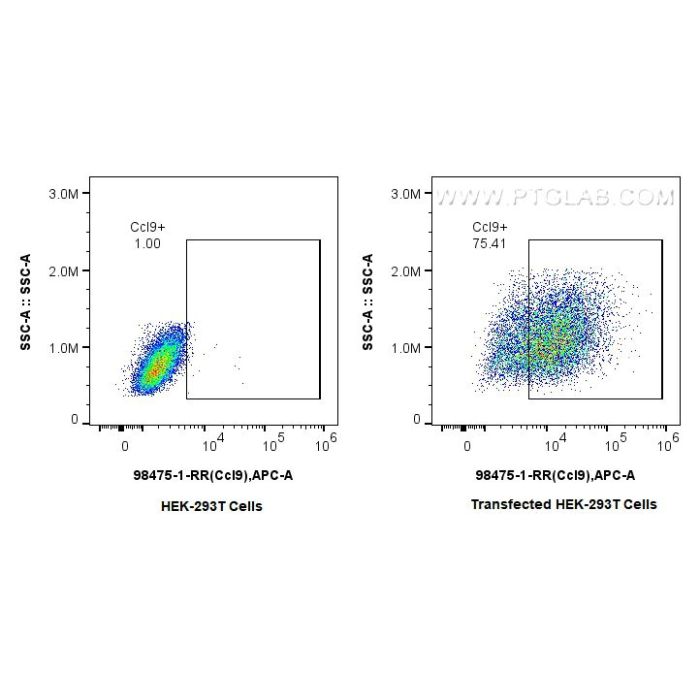
| Applications:Flow Cytometry (FC) (INTRA) | Formulation::PBS, Azide2 |
| Reactivity:Rabbit / IgG | Formulation::PBS, Azide3 |
| Type:CatNo: Eg3336 Product name: Recombinant Mouse CCL9 protein (rFc Tag) Source: mammalian cells-derived, pHZ-KIsec-C-rFc Tag: C-rFc Domain: 22-122 aa of NM_011338.2 Sequence: QITHATETKEVQSSLKAQQGLEIEMFHMGFQDSSDCCLSYNSRIQCSRFIGYFPTSGGCTRPGIIFISKRGFQVCANPSDRRVQRCIERLEQNSQPRTYKQ Predict reactive species | Formulation::PBS, Azide4 |
| RRID:20308 | Formulation::PBS, Azide5 |
| Storage Buffer:Q3U9T8 | Formulation::PBS, Azide6 |
| Background Information:Mouse C-C motif ligand 9 (CCL9), alternatively named macrophage inflammatory protein 1γ (MIP-1γ), was identified in 1995 and is homologous to the mouse CCL6, as well as human CCL23 and CCL15. It is noted that CCL9 is also known by various names such as macrophage inflammatory protein-1 gamma (MIP-1?), macrophage inflammatory protein-related protein-2 (MRP-2) and CCF18 in rodents. Monocytes and myeloid cell lines produce large quantities of CCL9, as do dendritic cells and T cells, in particular Th1 type T cells. Despite high baseline levels in circulation, it has become apparent that concentrations of CCL9 vary greatly in specific tissues with profound effects on health. For example, in the bone, CCL9 is produced at even higher levels, and is critical to osteoclast versus osteoblast differentiation of macrophages. There are also indications of a timed specific induction of CCL9 in skin wound healing and follicle-associated epithelium of the gut. | Formulation::PBS, Azide7 |
| biogegep8 | Formulation::PBS, Azide8 |
| biogegep9 | Formulation::PBS, Azide9 |
| Formulation::PBS, Azide0 | Applications:Flow Cytometry (FC) (INTRA)0 |