SHP2 Polyclonal antibody proteintech 20145-1-AP
$449.00
In stock
SKU
20145-1-AP
PTPN11/SHP2, PTPN11, NS1, NS 1, EC:3.1.3.48
| Host / Isotype: Rabbit / IgG | Class: Polyclonal |
| Reactivity: human, mouse, rat | Immunogen: CatNo: Ag13660 Product name: Recombinant human PTPN11 protein Source: e coli.-derived, PGEX-4T Tag: GST Domain: 1-357 aa of BC008692 Sequence: MTSRRWFHPNITGVEAENLLLTRGVDGSFLARPSKSNPGDFTLSVRRNGAVTHIKIQNTGDYYDLYGGEKFATLAELVQYYMEHHGQLKEKNGDVIELKYPLNCADPTSERWFHGHLSGKEAEKLLTEKGKHGSFLVRESQSHPGDFVLSVRTGDDKGESNDGKSKVTHVMIRCQELKYDVGGGERFDSLTDLVEHYKKNPMVETLGTVLQLKQPLNTTRINAAEIESRVRELSKLAETTDKVKQGFWEEFETLQQQECKLLYSRKEGQRQENKNKNRYKNILPFDHTRVVLHDGDPNEPVSDYINANIIMPEFETKCNNSKPKKSYIATQGCLQNTVNDFWRMVFQENSRVIVMTT Predict reactive species |
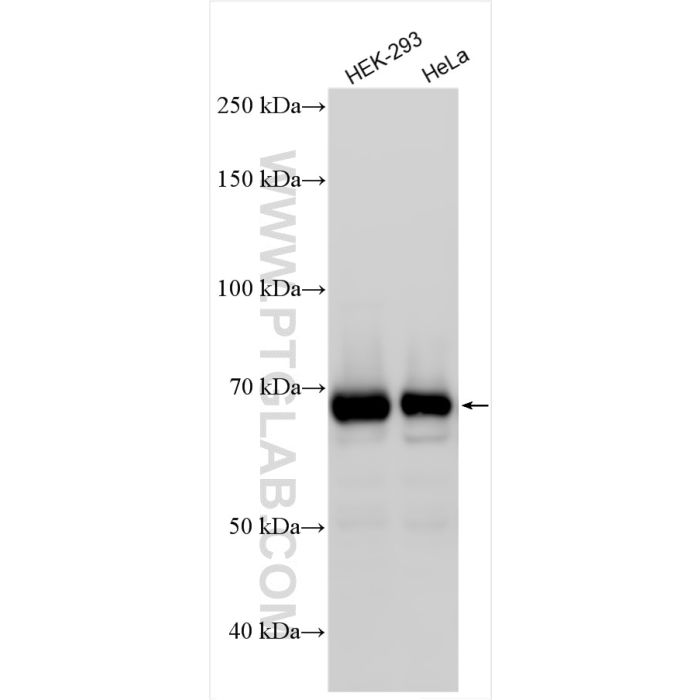
| Applications: WB, IHC, IF/ICC, IP, CoIP, ELISA, Cell treatment | Observed Molecular Weight: 597 aa, 68 kDa |
| Formulation: PBS, Azide, Glycerol | GenBank Accession Number: BC008692 |
| Conjugate: Unconjugated | Gene Symbol: PTPN11 |
| Tested Applications: Positive WB detected in | Gene ID (NCBI): 5781 |
| Application: Western Blot (WB) | RRID: AB_10699877 |
| Dilution: WB : 1:5000-1:50000 | Conjugate: Unconjugated |
| Tested Reactivity: Human, Mouse, Rat | Form: Liquid |
| Host / Isotype: Rabbit / IgG | Background Information: PTPN11(protein tyrosine phosphatase, non-receptor type 11) is also named as PTP-1D, PTP2, PTP2C, PTP3, SHP2, CFC, CFC, BPTP3, SH-PTP2, SH-PTP3, MGC14433 and belongs to the protein-tyrosine phosphatase family and non-receptor class 2 subfamily. It modulates and regulates signaling through numerous pathways, many of which are active in the developing endocardial cushions and implicated the ERK pathway as a central mechanism(PMID:19017799). Its signaling may play equally important roles in retinal survival in both physiological and pathological conditions(PMID:21576358). Defects in PTPN11 are the cause of LEOPARD syndrome type 1 (LEOPARD1), Noonan syndrome type 1 (NS1), juvenile myelomonocytic leukemia (JMML) and metachondromatosis (MC). It has 3 isoforms produced by alternative splicing. |