Caspase 9/P35 Polyclonal antibody proteintech 10380-1-AP
$449.00
In stock
SKU
10380-1-AP
CASP9, Caspase 9, Caspase 9/p35/p10, APAF 3, APAF3
| Host / Isotype: Rabbit / IgG | Class: Polyclonal |
| Reactivity: Human, Mouse And More (8) | Immunogen: CatNo: Ag0404 Product name: Recombinant human Caspase 9 protein Source: e coli.-derived, PGEX-4T Tag: GST Domain: 138-389 aa of BC002452 Sequence: DVGALESLRGNADLAYILSMEPCGHCLIINNVNFCRESGLRTRTGSNIDCEKLRRRFSSLHFMVEVKGDLTAKKMVLALLELAQQDHGALDCCVVVILSHGCQASHLQFPGAVYGTDGCPVSVEKIVNIFNGTSCPSLGGKPKLFFIQACGGEQKDHGFEVASTSPEDESPGSNPEPDATPFQEGLRTFDQLDAISSLPTPSDIFVSYSTFPGFVSWRDPKSGSWYVETLDDIFEQWAHSEDLQSLLLRVAN Predict reactive species |
| Applications: WB, IHC, IF/ICC, IP, RIP, ELISA | Observed Molecular Weight: 46 kDa |
| Formulation: PBS, Azide, Glycerol | GenBank Accession Number: BC002452 |
| Conjugate: Unconjugated | Gene Symbol: Caspase 9 |
| Tested Applications: Positive WB detected in | Gene ID (NCBI): 842 |
| Application: Western Blot (WB) | RRID: AB_2068632 |
| Dilution: WB : 1:300-1:1000 | Conjugate: Unconjugated |
| Tested Reactivity: Human, Mouse | Form: Liquid |
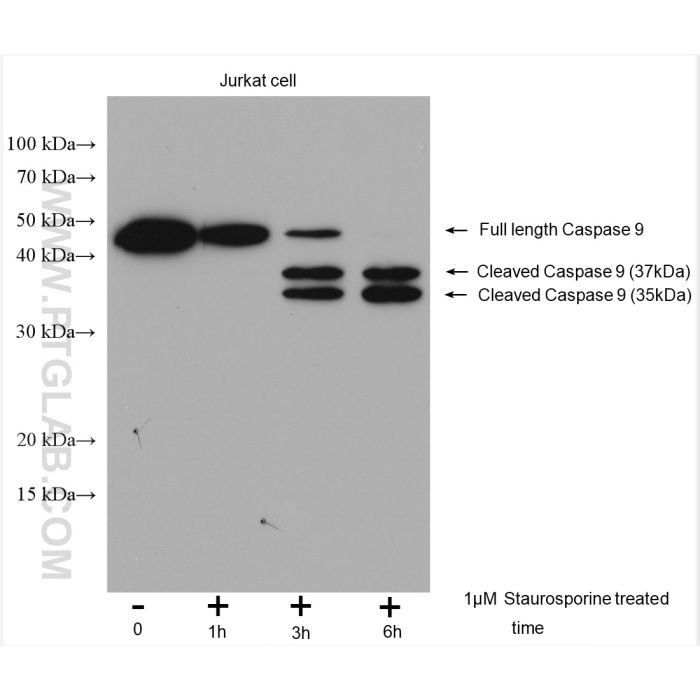
| Host / Isotype: Rabbit / IgG | Background Information: Caspase 9, apoptosis-related cysteine protease (CASP9, synonyms: MCH6, APAF3, APAF-3, ICE-LAP6, CASPASE-9c)is a member of the cysteine-aspartic acid protease (caspase) family. Sequential activation of caspases plays a central role in the execution-phase of cell apoptosis. Caspases exist as inactive proenzymes which undergo proteolytic processing at conserved aspartic residues to produce 2 subunits, large and small, that dimerize to form the active enzyme. Caspase 9 is processed by APAF1; this step is thought to be one of the earliest in the caspase activation cascade. 10380-1-AP can recognize the pre- and cleaved- caspase 9. In recent years, the localization of caspase 9 was a focus of interest. Beside its cytoplasmic distribution, a very extensive localization study was done on rat brain tissue, where caspase 9 was found located predominantly in the nucleus and to a lesser extend in the cytoplasm [PMID: 15541731]. |