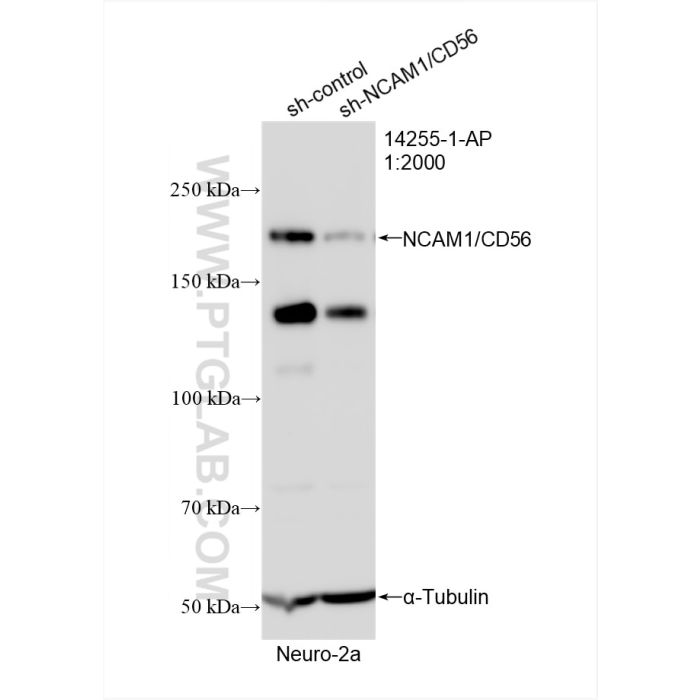
NCAM1/CD56 Polyclonal antibody proteintech 14255-1-AP
$449.00
In stock
SKU
14255-1-AP
CD56, NCAM1, MSK39, N CAM 1, NCAM
| Host / Isotype: Rabbit / IgG | Class: Polyclonal |
| Reactivity: human, mouse, rat, pig | Immunogen: CatNo: Ag5528 Product name: Recombinant human NCAM1/CD56 protein Source: e coli.-derived, PGEX-4T Tag: GST Domain: 30-352 aa of BC047244 Sequence: EISVGESKFFLCQVAGDAKDKDISWFSPNGEKLTPNQQRISVVWNDDSSSTLTIYNANIDDAGIYKCVVTGEDGSESEATVNVKIFQKLMFKNAPTPQEFREGEDAVIVCDVVSSLPPTIIWKHKGRDVILKKDVRFIVLSNNYLQIRGIKKTDEGTYRCEGRILARGEINFKDIQVIVNVPPTIQARQNIVNATANLGQSVTLVCDAEGFPEPTMSWTKDGEQIEQEEDDEKYIFSDDSSQLTIKKVDKNDEAEYICIAENKAGEQDATIHLKVFAKPKITYVENQTAMELEEQVTLTCEASGDPIPSITWRTSTRNISSEE Predict reactive species |
| Applications: WB, IHC, IF/ICC, IF-P, ELISA | Observed Molecular Weight: 95 kDa |
| Formulation: PBS, Azide, Glycerol | GenBank Accession Number: BC047244 |
| Conjugate: Unconjugated | Gene Symbol: NCAM1 |
| Tested Applications: Positive WB detected in | Gene ID (NCBI): 4684 |
| Application: Western Blot (WB) | RRID: ENSG00000149294 |
| Dilution: WB : 1:5000-1:50000 | Conjugate: AB_2149421 |
| Tested Reactivity: Human, Mouse, Rat, Pig | Form: Unconjugated |
| Host / Isotype: Rabbit / IgG | Background Information: Neural cell adhesion molecule 1 (NCAM1, also known as CD56) is a cell adhesion glycoprotein of the immunoglobulin (Ig) superfamily. It is a multifunction protein involved in synaptic plasticity, neurodevelopment, and neurogenesis. NCAM1 is expressed on human neurons, glial cells, skeletal muscle cells, NK cells and a subset of T cells, and the expression is observed in a wide variety of human tumors, including myeloma, myeloid leukemia, neuroendocrine tumors, Wilms' tumor, neuroblastoma, and NK/T cell lymphomas. Three major isoforms of NCAM1, with molecular masses of 120, 140, and 180 kDa, are generated by alternative splicing of mRNA (PMID: 9696812). The glycosylphosphatidylinositol (GPI)-anchored NCAM120 and the transmembrane NCAM140 and NCAM180 consist of five Ig-like domains and two fibronection-type III repeats (FNIII). All three forms can be posttranslationally modified by addition of polysialic acid (PSA) (PMID: 14976519). Several other isofroms have also been described (PMID: 1856291). |