OGT Polyclonal antibody proteintech 11576-2-AP
$449.00
In stock
SKU
11576-2-AP
EC:2.4.1.255, HRNT1, O GLCNAC, O-GlcNAc transferase subunit p110, O-linked N-acetylglucosamine transferase 110 kDa subunit
| Host / Isotype: Rabbit / IgG | Class: Polyclonal |
| Reactivity: human, mouse, rat | Immunogen: CatNo: Ag2160 Product name: Recombinant human OGT protein Source: e coli.-derived, PGEX-4T Tag: GST Domain: 1-400 aa of BC014434 Sequence: MASSVGNVADSTGLAELAHREYQAGDFEAAERHCMQLWRQEPDNTGVLLLLSSIHFQCRRLDRSAHFSTLAIKQNPLLAEAYSNLGNVYKERGQLQEAIEHYRHALRLKPDFIDGYINLAAALVAAGDMEGAVQAYVSALQYNPDLYCVRSDLGNLLKALGRLEEAKACYLKAIETQPNFAVAWSNLGCVFNAQGEIWLAIHHFEKAVTLDPNFLDAYINLGNVLKEARIFDRAVAAYLRALSLSPNHAVVHGNLACVYYEQGLIDLAIDTYRRAIELQPHFPDAYCNLANALKEKGSVAEAEDCYNTALRLCPTHADSLNNLANIKREQGNIEEAVRLYRKALEVFPEFAAAHSNLASVLQQQGKLQEALMHYKEAIRISPTFADAYSNMGNTLKEMQD Predict reactive species |
| Applications: WB, IHC, IF, IP, CoIP, IP-MS, ELISA | Observed Molecular Weight: 1046 aa, 117 kDa |
| Formulation: PBS, Azide, Glycerol | GenBank Accession Number: BC014434 |
| Conjugate: Unconjugated | Gene Symbol: OGT |
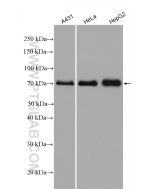
| Tested Applications: Positive WB detected in | Gene ID (NCBI): 8473 |
| Application: Western Blot (WB) | RRID: AB_2156943 |
| Dilution: WB : 1:2000-1:12000 | Conjugate: Unconjugated |
| Tested Reactivity: Human, Mouse, Rat | Form: Liquid |
| Host / Isotype: Rabbit / IgG | Background Information: O-linked N-acetylglucosamine transferase (OGT) catalyzes the attachment of N-acetylglucosamine (GlcNAc) monosaccharides to the hydroxyl group of serine or threonine residues of numerous nuclear and cytoplasmic proteins and may play important roles in a large number of diverse intracellular processes ranging from translational control, transcription, transcriptional repression, INS resistance and regulation of the cell cycle. It exists as a heterotrimeric complex with two 110 kDa and one 70 kDa subunits. Recent studies have shown that O-GlcNAcylation plays essential roles in cancer formation and progression. O-GlcNAcylation as well as OGT expression was found to be significantly elevated in the cancer tissues. |