CUX1 Polyclonal antibody proteintech 11733-1-AP
$449.00
In stock
SKU
11733-1-AP
COY1, Clox, CDP1, CDP/Cut, CDP
| Host / Isotype: Rabbit / IgG | Class: Polyclonal |
| Reactivity: Human, Mouse, Rat And More (1) | Immunogen: CatNo: Ag2335 Product name: Recombinant human CUX1 protein Source: e coli.-derived, PGEX-4T Tag: GST Domain: 1-341 aa of BC025422 Sequence: MAANVGSMFQYWKRFDLQQLQRELDATATVLANRQDESEQSRKRLIEQSREFKKNTPEDLRKQVAPLLKSFQGEIDALSKRSKEAEAAFLNVYKRLIDVPDPVPALDLGQQLQLKVQRLHDIETENQKLRETLEEYNKEFAEVKNQEVTIKALKEKIREYEQTLKNQAETIALEKEQKLQNDFAEKERKLQETQMSTTSKLEEAEHKVQSLQTALEKTRTELFDLKTKYDEETTAKADEIEMIMTDLERANQRAEVAQREAETLREQLSSANHSLQLASQIQKAPDVAIEVLTRSSLEVELAAKEREIAQLVEDVQRLQASLTKLRENSASQISQLEQQLS Predict reactive species |
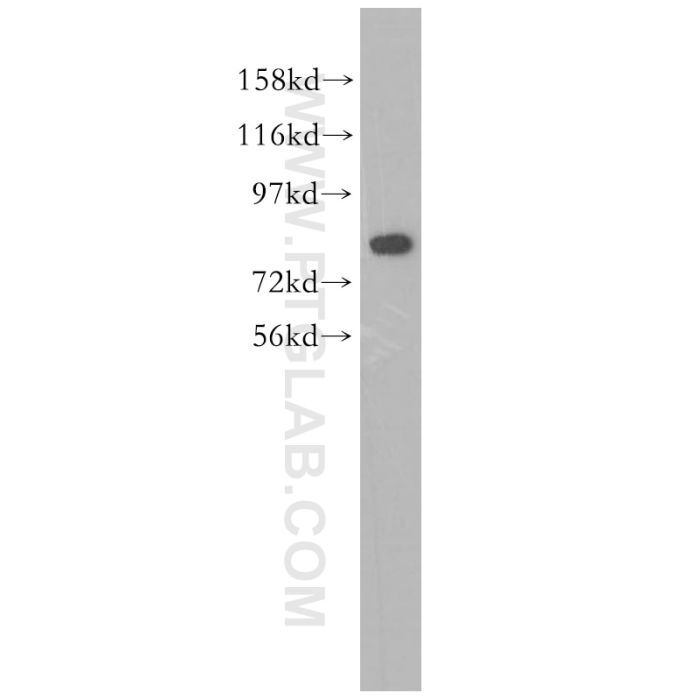
| Applications: WB, IHC, IF/ICC, IP, ELISA | Observed Molecular Weight: 676 aa, 77 kDa |
| Formulation: PBS, Azide, Glycerol | GenBank Accession Number: BC025422 |
| Conjugate: Unconjugated | Gene Symbol: CUX1 |
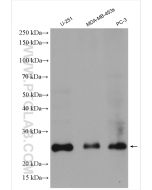
| Tested Applications: Positive WB detected in | Gene ID (NCBI): 1523 |
| Application: Western Blot (WB) | RRID: AB_2086995 |
| Dilution: WB : 1:2000-1:16000 | Conjugate: Unconjugated |
| Tested Reactivity: Human, Mouse, Rat | Form: Liquid |
| Host / Isotype: Rabbit / IgG | Background Information: CUX1 is a transcription factors that regulates a large number of genes and microRNAs involved in multiple cellular processes, such as DNA replication, progression into S phase and later, the spindle assembly checkpoint that controls progression through mitosis. Cux1, a marker of supragranular layers. CUX1 acts by preventing binding of positively-acting CCAAT factors to promoters to mediated its gene reperssion. Also it's a component of nf-munr repressor, and binds to the matrix attachment regions (MARs) (5' and 3') of the immunoglobulin heavy chain enhancer. It can represses T-cell receptor (TCR) beta enhancer function by binding to MARbeta, an ATC-rich DNA sequence located upstream of the TCR beta enhancer. CUX1 protein containing three cut repeats and a homeodomain called p200, there are several truncated isoforms that have been identified. These isoforms include a testis-specific isoform containing one cut repeat and the homeodomain called p55. In situ hybridization showed that mRNA for p55 was most abundant in round spermatids. Additional isoforms include p75, a protein similar in structure to p55, derived from the use of an alternate promoter in intron 20 ; the cut alternately spliced protein (CASP), a Golgi protein that contains amino-terminal sequences but none of the cut repeats or homeodomains ; and several other isoforms (p80, p90, p110, and p150) that appear to arise via proteolytic processing ]. This antibody can recognizes full-length p200 Cux1 and CASP protein (70~80kDa). |