HMGB1 Recombinant monoclonal antibody proteintech 82973-1-RR
$449.00
In stock
SKU
82973-1-RR
HMG1, HMG 1, High mobility group protein B1, High mobility group protein 1, high mobility group box 1
| Host / Isotype: Rabbit / IgG | Class: Recombinant |
| Reactivity: human, mouse, rat | Immunogen: CatNo: Ag1264 Product name: Recombinant human HMGB1 protein Source: e coli.-derived, PGEX-4T Tag: GST Domain: 1-215 aa of BC003378 Sequence: MGKGDPKKPRGKMSSYAFFVQTCREEHKKKHPDASVNFSEFSKKCSERWKTMSAKEKGKFEDMAKADKARYEREMKTYIPPKGETKKKFKDPNAPKRPPSAFFLFCSEYRPKIKGEHPGLSIGDVAKKLGEMWNNTAADDKQPYEKKAAKLKEKYEKDIAAYRAKGKPDAAKKGVVKAEKSKKKKEEEEDEEDEEDEEEEEDEEDEDEEEDDDDE Predict reactive species |
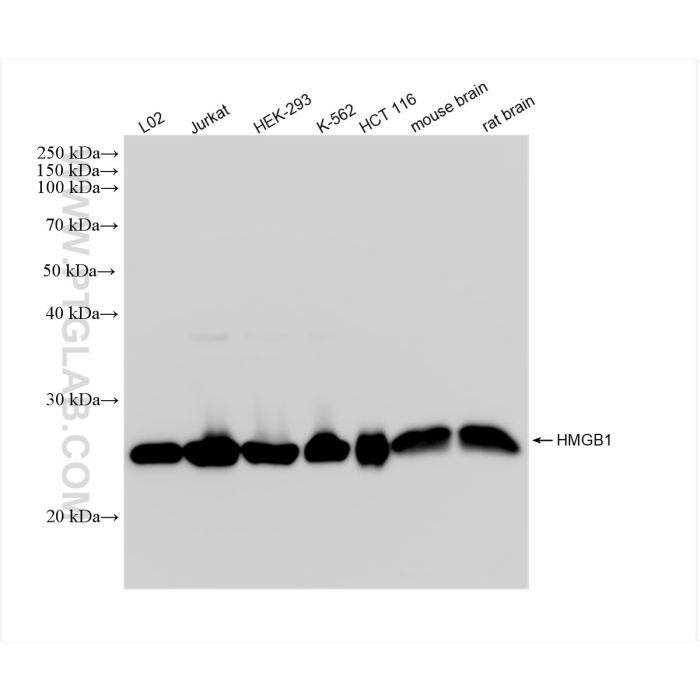
| Applications: WB, IHC, IF/ICC, FC (Intra), ELISA | Observed Molecular Weight: 25 kDa |
| Formulation: PBS, Azide, Glycerol | GenBank Accession Number: BC003378 |
| Conjugate: Unconjugated | Gene Symbol: HMGB1 |
| Tested Applications: Positive WB detected in | Gene ID (NCBI): 3146 |
| Application: Western Blot (WB) | RRID: AB_3670721 |
| Dilution: WB : 1:5000-1:50000 | Conjugate: Unconjugated |
| Tested Reactivity: Human, Mouse, Rat | Form: Liquid |
| Host / Isotype: Rabbit / IgG | Background Information: The HMG (high mobility group) proteins are nonhistone chromosomal proteins that is present in almost all eukaryotic cells, and it functions to stabilize NUCLEOSOME formation and acts as a transcription-factor-like protein that regulates the expression of several genes[PMID: 18160415]. Once injury, infection or other inflammatory stimuli, activated macrophages, mature dendritic cells and natural killer cells can secret HMGB1, which act as a crucial cytokine[PMID: 20163887]. HMGB1 also involved in V(D)J recombination by acting as a cofactor of the RAG complex, stimulating cleavage and RAG protein binding at the 23 bp spacer of conserved recombination signal sequences (RSS)[PMID: 19360789 ]. Act as a Heparin-binding protein that has a role in the extension of neurite-type cytoplasmic processes in developing cells. HMGB1 (high mobility group box 1) modulates gene expression in the nucleus, but certain immune cells secrete HMGB1 as an extracellular Alarmin to signal tissue damage.The nuclear HMGB1 relocalizes to the extracellular milieu in senescent human and mouse cells in culture and in vivo, which stimulated cytokine secretion through TLR-4 signaling (23649808). |