BAG3 Polyclonal antibody proteintech 10599-1-AP
$449.00
In stock
SKU
10599-1-AP
BAG-3, Bcl-2-associated athanogene 3, Bcl-2-binding protein Bis, BIS, Docking protein CAIR-1
| Host / Isotype: Rabbit / IgG | Class: Polyclonal |
| Reactivity: Human, Mouse, Rat And More (2) | Immunogen: CatNo: Ag0956 Product name: Recombinant human BAG3 protein Source: e coli.-derived, PGEX-4T Tag: GST Domain: 275-575 aa of BC006418 Sequence: SREGSPARSSTPLHSPSPIRVHTVVDRPQQPMTHRETAPVSQPENKPESKPGPVGPELPPGHIPIQVIRKEVDSKPVSQKPPPPSEKVEVKVPPAPVPCPPPSPGPSAVPSSPKSVATEERAAPSTAPAEATPPKPGEAEAPPKHPGVLKVEAILEKVQGLEQAVDNFEGKKTDKKYLMIEEYLTKELLALDSVDPEGRADVRQARRDGVRKVQTILEKLEQKAIDVPGQVQVYELQPSNLEADQPLQAIMEMGAVAADKGKKNAGNAEDPHTETQQPEATAAATSNPSSMTDTPGNPAAP Predict reactive species |
| Applications: WB, IHC, IF/ICC, IP, CoIP, ELISA | Observed Molecular Weight: 61 kDa |
| Formulation: PBS, Azide, Glycerol | GenBank Accession Number: BC006418 |
| Conjugate: Unconjugated | Gene Symbol: BAG3 |
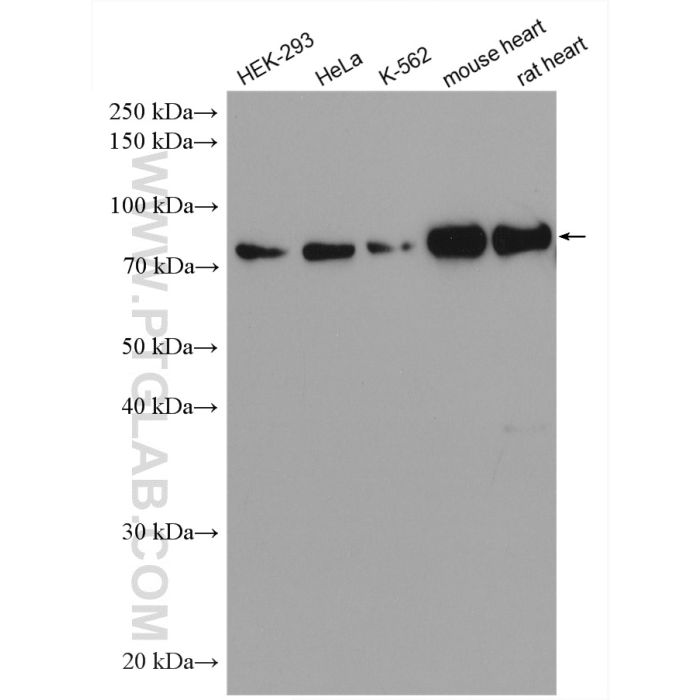
| Tested Applications: Positive WB detected in | Gene ID (NCBI): 9531 |
| Application: Western Blot (WB) | RRID: AB_2062602 |
| Dilution: WB : 1:30000-1:60000 | Conjugate: Unconjugated |
| Tested Reactivity: Human, Mouse, Rat | Form: Liquid |
| Host / Isotype: Rabbit / IgG | Background Information: BAG3 (Bcl2-associated athanogene 3) belongs to the BAG protein family, the co-chaperone that binds to Hsc70/Hsp70 through the BAG domain and modulates their activity in polypeptide folding. BAG3 contains also a WW domain and a proline-rich (PXXP) repeat, that mediate binding to partners different from Hsp70. Through interacting with different molecular partner, BAG3 influences several cell processes, such as apoptosis, autophagy and cell motility. BAG3 protein has been reported to sustain cell survival, resistance to therapy, and/or motility and metastatization in several tumor types, thus being identified as a potential target for anticancer therapies. In addition, defects in BAG3 are the cause of some myopathy. BAG3 normally migrates around 74-80 kDa; a slightly different molecular weight or a doublet form can be observed in some cell types and/or following cell exposure to stressors. A synaptosome associated form of 40 kDa has recently been described. |