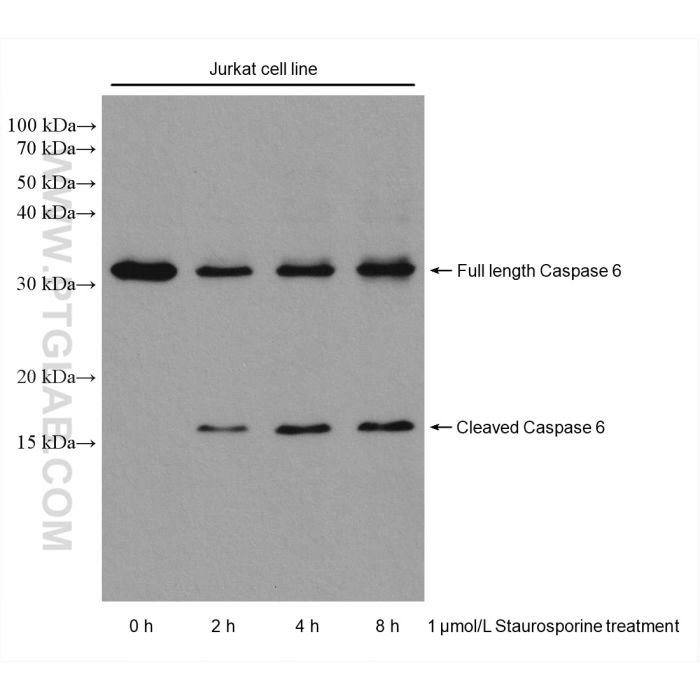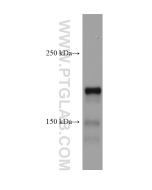
Caspase 6 Monoclonal antibody proteintech 67825-1-Ig
$449.00
In stock
SKU
67825-1-Ig
Apoptotic protease Mch 2, CASP 6, CASP6, Caspase 6, Caspase6, MCH2
| Host / Isotype: Mouse / IgG2b | Class: Monoclonal |
| Reactivity: Human And More (1) | Immunogen: CatNo: Ag20534 Product name: Recombinant human Caspase 6 protein Source: e coli.-derived, PET28a Tag: 6*His Domain: 59-222 aa of BC000305 Sequence: LTLPERRGTCADRDNLTRRFSDLGFEVKCFNDLKAEELLLKIHEVSTVSHADADCFVCVFLSHGEGNHIYAYDAKIEIQTLTGLFKGDKCHSLVGKPKIFIIQACRGNQHDVPVIPLDVVDNQTEKLDTNITEVDAASVYTLPAGADFLMCYSVAEGYYSHRET Predict reactive species |
| Applications: WB, IF/ICC, ELISA | Observed Molecular Weight: 33 kDa, 22 kDa |
| Formulation: PBS, Azide, Glycerol | GenBank Accession Number: BC000305 |
| Conjugate: Unconjugated | Gene Symbol: Caspase 6 |
| Tested Applications: Positive WB detected in | Gene ID (NCBI): 839 |
| Application: Western Blot (WB) | RRID: AB_2918587 |
| Dilution: WB : 1:1000-1:4000 | Conjugate: Unconjugated |
| Tested Reactivity: Human | Form: Liquid |
| Host / Isotype: Mouse / IgG2b | Background Information: Caspase-6 belongs to caspase family of cysteinyl-aspartate specific proteases.Precursor of CASP6 produces two subunits, large (18kDa) and small (16kDa) that dimerize. It cleaves poly(ADP-ribose) polymerase, as well as lamins and is involved in the activation cascade of caspases responsible for apoptosis execution. Researches showed that CASP6 could be an early instigator of neuronal dysfunction and regulates B cell activation and differentiation into plasma cells by modifying cell cycle entry. IRAK3 is an important target for CASP6. It can reveal five bands of 28, 32, 36, 49, and 64 kDa in human neurons and fetal brain in western blot, the 32 and 28 kDa bands represent procaspase-6 and pro-arm caspase-6. Procaspase-6 is more abundant than pro-arm caspase-6 in adult tissue, whereas pro-arm caspase-6 is more abundant than pro-caspase-6 in fetal brain and cultured neurons. The higher molecular mass bands at 49 and 64 kDa likely represent dimers of p28 and p32.(PMID:10438520). In rat testis, it can be detected two bands of 34 kDa and 12 kDa or 14 kDa(PMID:12538628). |