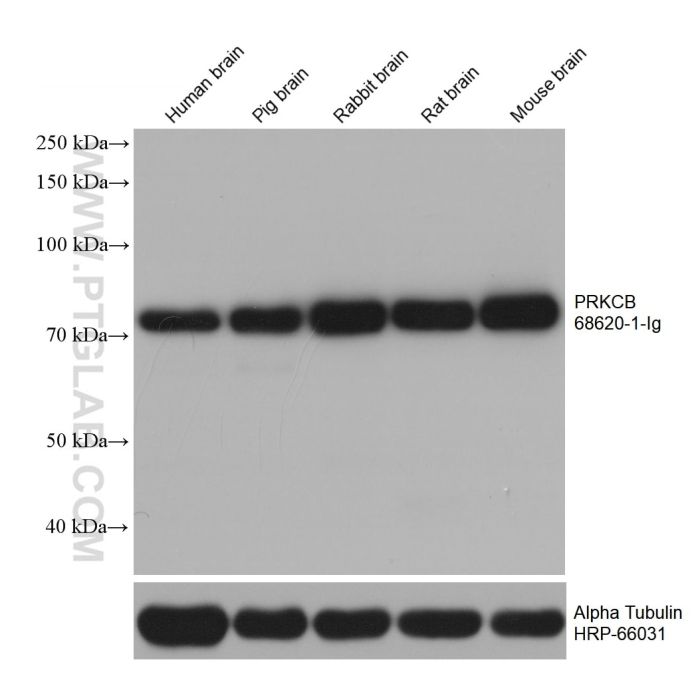
PRKCB Monoclonal antibody proteintech 68620-1-Ig
$449.00
In stock
SKU
68620-1-Ig
PKC beta, 4B7A1, EC:2.7.11.13, pan-PKC, PKC B
| Host / Isotype: Mouse / IgG1 | Class: Monoclonal |
| Reactivity: human, mouse, rat, pig, rabbit | Immunogen: CatNo: Ag33693 Product name: Recombinant human PRKCB protein Source: e coli.-derived, PET28a Tag: 6*His Domain: 342-598 aa of BC036472 Sequence: FNFLMVLGKGSFGKVMLSERKGTDELYAVKILKKDVVIQDDDVECTMVEKRVLALPGKPPFLTQLHSCFQTMDRLYFVMEYVNGGDLMYHIQQVGRFKEPHAVFYAAEIAIGLFFLQSKGIIYRDLKLDNVMLDSEGHIKIADFGMCKENIWDGVTTKTFCGTPDYIAPEIIAYQPYGKSVDWWAFGVLLYEMLAGQAPFEGEDEDELFQSIMEHNVAYPKSMSKEAVAICKGLMTKHPGKRLGCGPEGERDIKEHA Predict reactive species |
| Applications: WB, IHC, ELISA | Observed Molecular Weight: 673 aa, 77 kDa |
| Formulation: PBS, Azide, Glycerol | GenBank Accession Number: BC036472 |
| Conjugate: Unconjugated | Gene Symbol: PRKCB |
| Tested Applications: Positive WB detected in | Gene ID (NCBI): 5579 |
| Application: Western Blot (WB) | RRID: AB_3085312 |
| Dilution: WB : 1:2000-1:10000 | Conjugate: Unconjugated |
| Tested Reactivity: Human, Mouse, Rat, Pig, Rabbit | Form: Liquid |
| Host / Isotype: Mouse / IgG1 | Background Information: Protein kinase C (PKC) is a family of serine- and threonine-specific protein kinases that can be activated by calcium and second messenger diacylglycerol. Protein kinase Cs (PKCs) are signaling molecules that play key roles in many cellular processes, including secretion, gene expression, proliferation, and muscle contraction. The PKC family is broadly divided into three subgroups: classical, novel, and atypical PKCs. These subgroups differ in both protein sequences and mechanistic requirements for catalytic activity. PKC beta is one of the PKC family members. PKC beta has been reported to be involved in many different cellular functions, such as B cell activation, apoptosis induction, endothelial cell proliferation, and intestinal sugar absorption. Studies in mice also suggest that this kinase may also regulate neuronal functions and correlate fear-induced conflict behavior after stress. |