CKB/CKM Monoclonal antibody proteintech 66764-1-Ig
$449.00
In stock
SKU
66764-1-Ig
CKB, KCRB, 2B7C3, B CK, B-CK
| Host / Isotype: Mouse / IgG2a | Class: Monoclonal |
| Reactivity: human, mouse | Immunogen: CatNo: Ag7933 Product name: Recombinant human CKB protein Source: e coli.-derived, PET28a Tag: 6*His Domain: 1-381 aa of BC001190 Sequence: MPFSNSHNALKLRFPAEDEFPDLSAHNNHMAKVLTPELYAELRAKSTPSGFTLDDVIQTGVDNPGHPYIMTVGCVAGDEESYEVFKDLFDPIIEDRHGGYKPSDEHKTDLNPDNLQGGDDLDPNYVLSSRVRTGRSIRGFCLPPHCSRGERRAIEKLAVEALSSLDGDLAGRYYALKSMTEAEQQQLIDDHFLFDKPVSPLLLASGMARDWPDARGIWHNDNKTFLVWVNEEDHLRVISMQKGGNMKEVFTRFCTGLTQIETLFKSKDYEFMWNPHLGYILTCPSNLGTGLRAGVHIKLPNLGKHEKFSEVLKRLRLQKRGTGGVDTAAVGGVFDVSNADRLGFSEVELVQMVVDGVKLLIEMEQRLEQGQAIDDLMPAQK Predict reactive species |
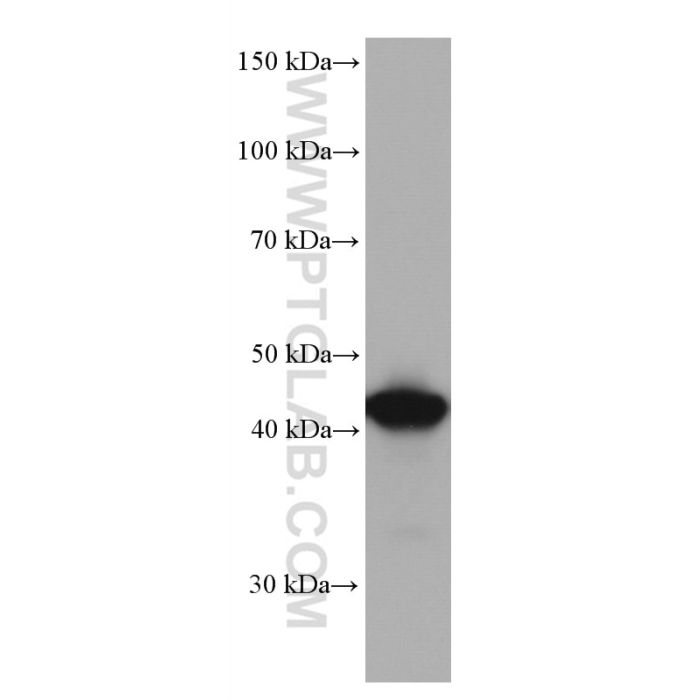
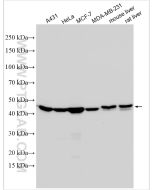
| Applications: WB, IHC, ELISA | Observed Molecular Weight: 43 kDa |
| Formulation: PBS, Azide, Glycerol | GenBank Accession Number: BC001190 |
| Conjugate: Unconjugated | Gene Symbol: CKB |
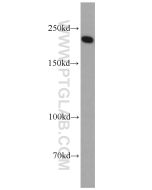
| Tested Applications: Positive WB detected in | Gene ID (NCBI): 1152 |
| Application: Western Blot (WB) | RRID: AB_2882110 |
| Dilution: WB : 1:10000-1:50000 | Conjugate: Unconjugated |
| Tested Reactivity: Human, Mouse | Form: Liquid |
| Host / Isotype: Mouse / IgG2a | Background Information: CKBB, also named as B-CK and CKB, is a member of the ATP:guanido phosphotransferase protein family. It is a cytoplasmic enzyme involved in energy homeostasis. CKBB reversibly catalyzes the transfer of phosphate between ATP and various phosphogens such as creatine phosphate. It acts as a homodimer in brain as well as in other tissues, and as a heterodimer with a similar muscle isozyme in heart. CK isoenzymes play a central role in energy transduction in tissues with large, fluctuating energy demands, such as skeletal muscle, heart, brain and spermatozoa. CK MB consists of a dimer of nonidentical chains. With MM being the major form in skeletal muscle and myocardium, MB existing in myocardium, and BB existing in many tissues, especially brain. This antibody can recognize both CKB and CKM due to the high homology. |