PARP1 Monoclonal antibody proteintech 66520-1-Ig
$449.00
In stock
SKU
66520-1-Ig
ARTD1, ADPRT1, ADPRT 1, ADPRT, ADP-ribosyltransferase diphtheria toxin-like 1
| Host / Isotype: Mouse / IgG1 | Class: Monoclonal |
| Reactivity: Human, Mouse, Rat And More (2) | Immunogen: CatNo: Ag19173 Product name: Recombinant human PARP1 protein Source: e coli.-derived, PET28a Tag: 6*His Domain: 1-327 aa of BC037545 Sequence: MAESSDKLYRVEYAKSGRASCKKCSESIPKDSLRMAIMVQSPMFDGKVPHWYHFSCFWKVGHSIRHPDVEVDGFSELRWDDQQKVKKTAEAGGVTGKGQDGIGSKAEKTLGDFAAEYAKSNRSTCKGCMEKIEKGQVRLSKKMVDPEKPQLGMIDRWYHPGCFVKNREELGFRPEYSASQLKGFSLLATEDKEALKKQLPGVKSEGKRKGDEVDGVDEVAKKKSKKEKDKDSKLEKALKAQNDLIWNIKDELKKVCSTNDLKELLIFNKQQVPSGESAILDRVADGMVFGALLPCEECSGQLVFKSDAYYCTGDVTAWTKCMVKTQT Predict reactive species |
| Applications: WB, IHC, IF/ICC, FC (Intra), IP, CoIP, ELISA | Observed Molecular Weight: 1014 aa, 113 kDa |
| Formulation: PBS, Azide, Glycerol | GenBank Accession Number: BC037545 |
| Conjugate: Unconjugated | Gene Symbol: PARP1 |
| Tested Applications: Positive WB detected in | Gene ID (NCBI): 142 |
| Application: Western Blot (WB) | RRID: AB_2881883 |
| Dilution: WB : 1:5000-1:50000 | Conjugate: Unconjugated |
| Tested Reactivity: Human, Mouse, Rat | Form: Liquid |
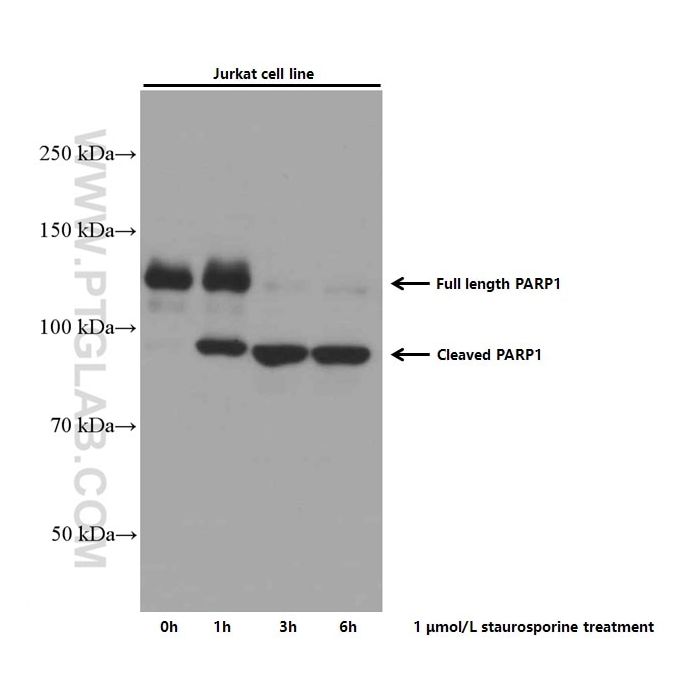
| Host / Isotype: Mouse / IgG1 | Background Information: PARP1 (poly(ADP-ribose) polymerase 1) is a nuclear enzyme catalyzing the poly(ADP-ribosyl)ation of many key proteins in vivo. The normal function of PARP1 is the routine repair of DNA damage. Activated by DNA strand breaks, the PARP1 is cleaved into an 85 to 89-kDa COOH-terminal fragment and a 24-kDa NH2-terminal peptide by caspases during the apoptotic process. The appearance of PARP fragments is commonly considered an important biomarker of apoptosis. In addition to caspases, other proteases like calpains, cathepsins, granzymes, and matrix metalloproteinases (MMPs) have also been reported to cleave PARP1 and give rise to fragments ranging from 42-89-kDa. This antibody was generated against the N-terminal region of human PARP1 and it recognizes the full-length as well as the cleavage of the PARP1. |