uPAR/CD87 Polyclonal antibody proteintech 10286-1-AP
$449.00
In stock
SKU
10286-1-AP
| Host / Isotype: Rabbit / IgG | Class: Polyclonal |
| Reactivity: Human, Mouse And More (1) | Immunogen: CatNo: Ag0187 Product name: Recombinant human uPAR, PLAUR protein Source: e coli.-derived, PGEX-4T Tag: GST Domain: 1-136 aa of BC002788 Sequence: MGHPPLLPLLLLLHTCVPASWGLRCMQCKTNGDCRVEECALGQDLCRTTIVRLWEEGEELELVEKSCTHSEKTNRTLSYRTGLKITSLTEVVCGLDLCNQGNSGRAVTYSRSRYLECISCGSSDMSCERGRHQSLQ Predict reactive species |
| Applications: WB, IHC, IF/ICC, CoIP, ELISA | Observed Molecular Weight: 37 kDa |
| Formulation: PBS, Azide, Glycerol | GenBank Accession Number: BC002788 |
| Conjugate: Unconjugated | Gene Symbol: uPAR |
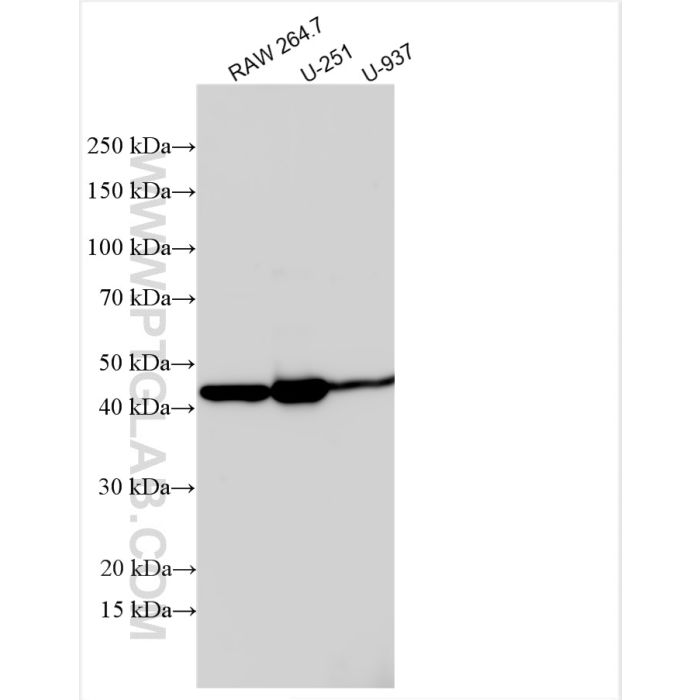
| Tested Applications: Positive WB detected in | Gene ID (NCBI): 5329 |
| Application: Western Blot (WB) | RRID: AB_10667460 |
| Dilution: WB : 1:1000-1:8000 | Conjugate: Unconjugated |
| Tested Reactivity: Human, Mouse | Form: Liquid |
| Host / Isotype: Rabbit / IgG | Background Information: uPAR is a 45-65 kDa, highly glycosylated, GPI-anchored membrane protein. In addition to the membrane-anchored form, uPAR is released from the plasma membrane by cleavage of the GPI anchor and can be found as a soluble form (suPAR). uPAR contains three homologous domains (D1-D3) of which the N-terminal one (D1) represents the uPA-binding domain. After binding to uPAR, uPA cleaves plasminogen, generating the active protease plasmin which is involved in a wide variety of physiologic and pathologic processes. In addition to regulating proteolysis, uPAR has important function in cell adhesion, migration and proliferation. Studies reveal that uPAR expression is elevated during inflammation and tissue remodelling and in many human cancers, in which it frequently indicates poor prognosis. (PMID 20027185; 12461559) |