PPAR Gamma Polyclonal antibody Proteintech 16643-1-AP
$299.00
In stock
SKU
16643-1-AP
PPARG, NR1C3, Peroxisome proliferator-activated receptor gamma, PPAR-gamma, PPARγ
| Formulation::PBS, Azide, Glycerol | Formulation::PBS, Azide, Glycerol1 |
| Applications:Western Blot (WB) | Formulation::PBS, Azide, Glycerol2 |
| Reactivity:Human, Mouse, Rat, Rabbit, Monkey, Chicken, Zebrafish, Hamster, Sheep, Goat | Formulation::PBS, Azide, Glycerol3 |
| Type:Antibody | Formulation::PBS, Azide, Glycerol4 |
| RRID:BC006811 | Formulation::PBS, Azide, Glycerol5 |
| Storage Buffer:Unconjugated | Formulation::PBS, Azide, Glycerol6 |
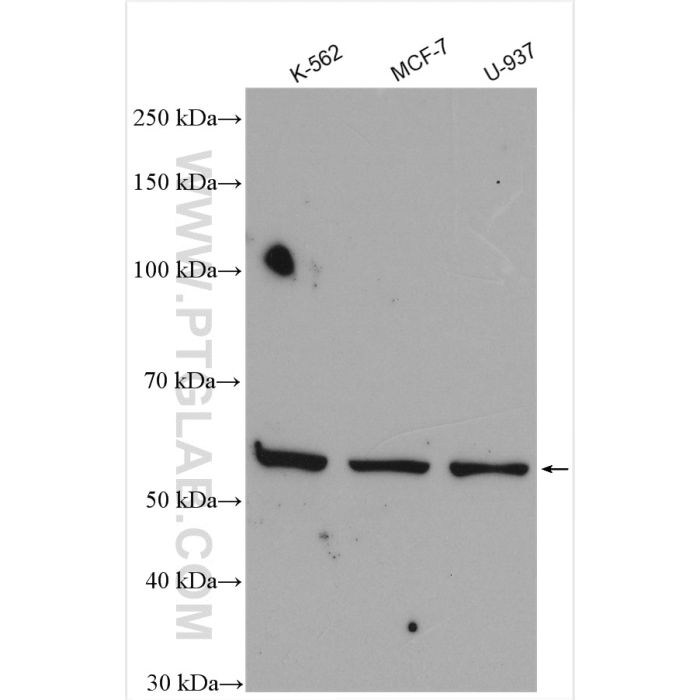
| Background Information:Peroxisome Proliferator-Activated Receptors (PPARs) are ligand-activated intracellular transcription factors, members of the nuclear hormone receptor superfamily (NR), that includes estrogen, thyroid hormone receptors, retinoic acid, Vitamin D3 as well as retinoid X receptors (RXRs). The PPAR subfamily consists of three subtypes encoded by distinct genes denoted PPARα (NR1C1), PPARβ/δ (NR1C2) and PPARγ (NR1C3), which are activated by selective ligands. PPARγ, also named as PPARG, contains one nuclear receptor DNA-binding domain and is a receptor that binds peroxisome proliferators such as hypolipidemic drugs and fatty acids. It plays an important role in the regulation of lipid homeostasis, adipogenesis, ins resistance, and development of various organs. Defects in PPARG are the cause of familial partial lipodystrophy type 3 (FPLD3) and may be associated with susceptibility to obesity. Defects in PPARG can lead to type 2 ins-resistant diabetes and hypertension. PPARG mutations may be associated with colon cancer. Genetic variations in PPARG are associated with susceptibility to glioma type 1 (GLM1). PPARG has two isoforms with molecular weight 57 kDa and 54 kDa (PMID: 9831621), but modified PPARG is about 67 KDa (PMID: 16809887). PPARG2 is a splice variant and has an additional 30 amino acids at the N-terminus (PMID: 15689403). Experimental data indicate that a 45 kDa protein displaying three different sequences immunologically related to the nuclear receptor PPARG2 is located in mitochondria (mt-PPAR). However, the molecular weight of this protein is clearly less when compared to that of PPARG2 (57 kDa) (PMID: 10922459). PPARG has been reported to be localized mainly (but not always) in the nucleus. PPARG can also be detected in the cytoplasm and was reported to possess extra-nuclear/non-genomic actions (PMID: 17611413; 19432669; 14681322). | Formulation::PBS, Azide, Glycerol7 |
| biogegep8 | Formulation::PBS, Azide, Glycerol8 |
| biogegep9 | Formulation::PBS, Azide, Glycerol9 |
| Formulation::PBS, Azide, Glycerol0 | Applications:Western Blot (WB)0 |